You Are Variations
Anchan/Anna Daučíková, Christina Della Giustina
A collaboration between Vleeshal and If I Can’t Dance
18 January – 22 March 2026
Vleeshal
Curators: Martha Jager, Sara Giannini
YOu are varIAtionS presented for the first time in the Netherlands, the artistic collaboration between Anchan/Anna Daučíková (1950, SK/CZ) and Christina Della Giustina (1965, CH/NL) — a dialogue that began in the mid-1990s and continues to this day. Emerging from the artistic and activist networks that were reshaped after the fall of the Berlin Wall, their exchange unfolded across different cultural contexts: starting in Switzerland, followed by the Czech Republic, Slovakia, Ukraine, Italy, and the Netherlands. As active members of feminist and lesbian circles, their practices were formed by the struggles and desires of those years of opening, hope, and acceleration between the end of the Cold War and the dawn of the new millennium. The exhibition looked back at those seminal years from the perspective of the present, emphasizing how their engagement with feminist, queer, and ecological urgencies resonated powerfully today.
The exhibition unfolded across three variations, echoing the artists' explorations of transformation, interstitial thinking and processes of becoming. As such, the exhibition traced the artist's experiments in performance, video, photography, drawing and installation. Undoing fixed identities, constructs, and national idioms, the works opened onto an emergent, corporeal language. Hands and mouths, words and water, chains, glass, and stones became characters that spoke through the space of Vleeshal, forming a living body-language. With their friendship as a curatorial principle, YOu arE VAriations also offered an exercise in feminist art history, shifting attention from individual authorship to the often-unacknowledged roles of networks, friendships, and collaborations. In this sense, the exhibition understood the artists’ trajectories as membranes that breathed, changed, and morphed through dialogue — and ultimately through life.
Introduction to the artists, collaboration, and context
Developed through close exchange between the artists and the curators, the exhibition brought together collaborative and individual works by both artists, with a focus on the years after their 1994 encounter at Fundaziun Nairs, an art residency in a former bathhouse in the Swiss spa town of Scuol. Here, Della Giustina — then a fresh philosophy graduate — was the residency’s curator, while Daučíková, already an established artist and LGBTQ+ advocate, joined through a programme inviting artists from the former Eastern Bloc. Following what both recalled as an “electric handshake” upon Daučíková’s arrival in the middle of the night, the two began a fervent artistic, intellectual, and romantic exchange that would profoundly shape their lives, both personally and professionally.
Coming from different contexts and with no shared spoken language, Daučíková and Della Giustina nonetheless found a deep mutual understanding in their respective urge to undo conventions and power structures, and to counter experiences of unbelonging and alienation. For Daučíková, this stemmed from the oppression of gender binaries, heteronormative structures, and the imperial context of the Soviet Union. For Della Giustina, it was rooted in her upbringing in the German-speaking part of Switzerland as the child of Italian migrant workers — an experience that led her to forcibly forget her mother tongue. While together at the residency in Scuol, they bought their first video camera and began communicating through proxy languages: the camera lens, the vocabularies of queer erotic desire, and the Italian language — for Della Giustina, a buried mother tongue, and for Daučíková, an activist language learned through her connection to the Italian feminist Marxist group Le Diottime.
While at Scuol, Della Giustina stepped away from curation and theoretical language to become an artist herself, using language as spatial and sonic material. Daučíková, having worked previously with abstract painting and glass, turned toward the gestures of their own body. Together, they started experimenting across media, allowing their research to live and transform in multiple forms, often also in collaboration with other artists in their circles. The seminal project Acquabelle spoke to this attitude. Developed in 1995 after leaving Scuol, Acquabelle was a video of the artists’ hands fondling under water, which had, throughout the years, often been shown in juxtaposition with Sprache (a language), a text-and-glass installation and a live performance.
Alongside their collaborations, yOu are VARIations also featured projects developed during the time in which Della Giustina chose to train as an artist at the Jan van Eyck Academie in Maastricht (1996–98), a decision that eventually led her to settle in the Netherlands. Her relocation gradually marked the beginning of the end of their relationship, as Daučíková decided instead to live between Prague and Bratislava. The works from this period were imbued with both the synergy of their connection and the seeds of different futures. Over the following years, through videos and collages, Daučíková developed what they called the “mental body” — a deliberation on the “in-betweeness” of the body beyond gender categories, conventions, and grammars; a body that was a gestural language and signal system in itself. Della Giustina, meanwhile, moved toward working with water and sound as fields of radical openness, fluidity, and movement. The exhibition foregrounded these affinities, showing how they emerged through their encounter and how they continued to evolve through sustained dialogue over the years.
Concept of variations
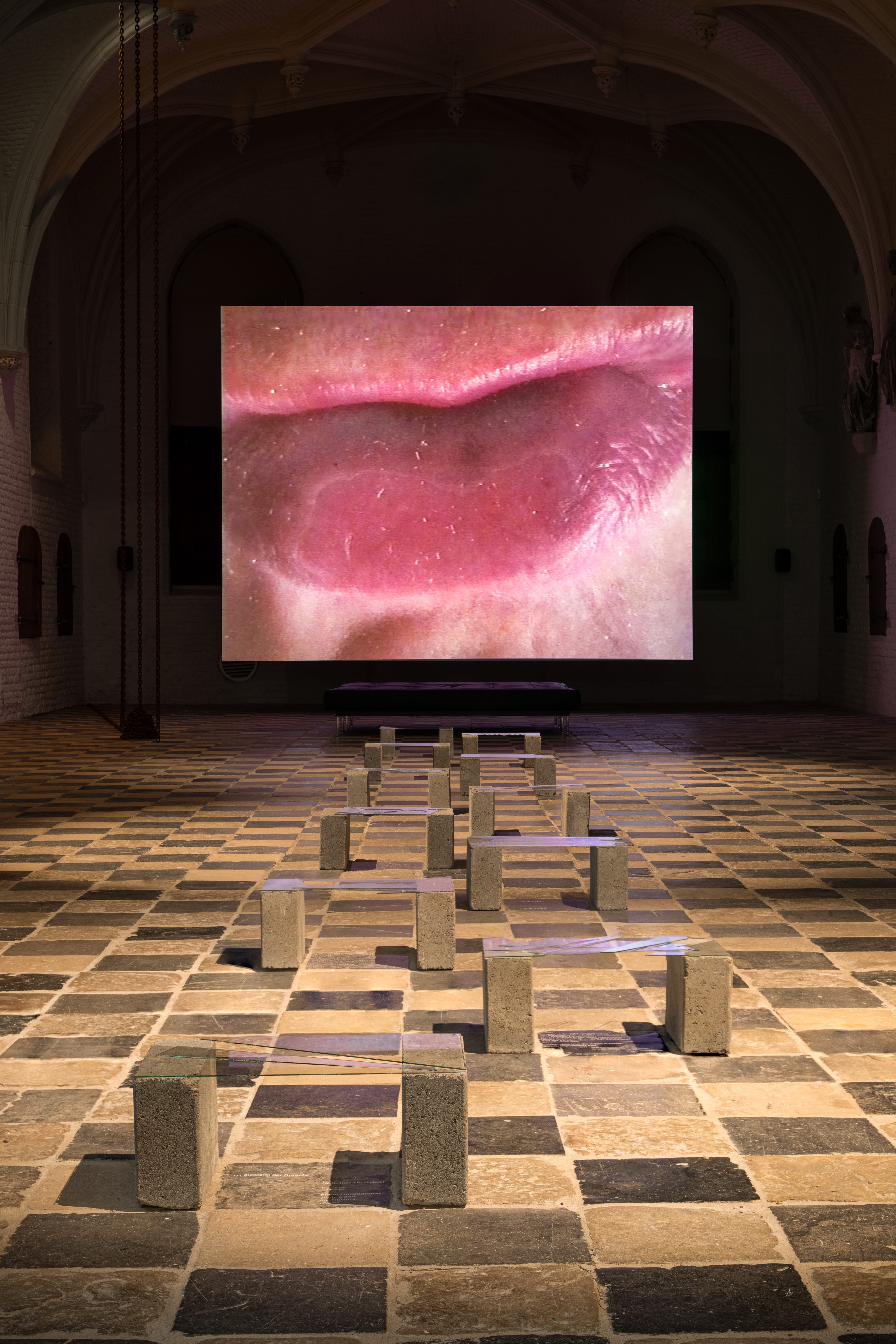
Collaging, seriality, fluidity and variation traversed and bound the artists’ work. In their respective archives, many works resist fixed form — travelling across formats and media, evolving through subsequent iterations and recombinations. Embracing this shared attitude, the exhibition unfolded in three variations. With each passing month, certain works shifted within the space, disappearing and reappearing in a new format. The large-scale projection in the back set the pace of the three variations, which developed through a triangulation between the projection, four CRT monitors and a stack of prints— a temporary sculpture, gradually transformed by the visitor. Every month, a different video was screened, with the previous video traveling either to the monitors, where it was juxtaposed with other video work, or made available to the visitor as a printed video still. The four monitors were conceived as a combinatory space where relations emerged between the different videos. One of them featured a compilation of archival materials combined by the exhibition curators to show earlier versions of the exhibited works, as well as photographs of the artists together throughout the decades.
The theme of variation was also expressed through readaptations of earlier works in conversation with the space of Vleeshal and the introduction of site-specific presentation structures. The central floor piece, partially printed directly on the Vleeshal floor, reimagined the text and installation work Sprache (a language) from 1995 and formed the spine of the exhibition. Two aluminum structures conceived specifically for this exhibition extended from Vleeshal’s characteristic wall enclaves, forming two tongues reaching toward one another and supporting individual works that explored non-normative erotic desire: Daučíková’s collages Something About Me (1997) and Della Giustina’s slide-show push to (re-)start (1996–1997).
The exhibition title YOu are VarIAtions was derived from Della Giustina’s PhD research (2022) and series of sound pieces you are variations, versions 01 – 09, 2011–2019. Engaging with sound and biology, through this long-term project Della Giustina sought a language at the borders of language, relating herself to the water contained in trees. During this process she developed ‘/wi/:’ a sonic, and corresponding graphic sign for a new personal pronoun that stood for an inclusive relationship between herself and the tree. This inclusive ‘‘/wi/’ resonated with Daučíková’s quest for the anti-essentialist language of the mental body. Through the cut-outs and repetition of body-gestures, such as in their video work Queen’s Finger (1998) and photo collages Something About Me (1997), this language did not aim to capture and define, but to undo the political fiction of gender identity.
This convergence was exemplified in you are variations, version 08/03 (2019), the most recent collaborative work in the exhibition. Roughly twenty years after their last collaboration, Daučíková invited Della Giustina as a guest professor in Prague. The fellowship led to the development of the composition you are variations, version 08/01 (2018), scored for an orchestra and electronics in collaboration with the Spruce and Beech trees of the Načetín forest plot in the Czech Ore Mountains. The composition was interpreted through three live concerts, with Daučíková joining the ensemble as ‘video performer’ and receiving full freedom over the documentation of the events. In the third and final interpretation, after filming in different styles, they introduced their hand into the frame and moved in response to the music. In these hand gestures, one glimpsed echoes of Acquabelle flashing through history, but now entangled with Della Giustina’s sonic research and Daučíková’s ongoing body-work. The collaboration includes the individual, the individual includes the collaboration. The self is in the other, the other is in the self. You are variations.
This exhibition took place in three variations
I 18.1–8.2.2026
II 9.2–1.3.2026
III 2.3–22.3.2026
Inter-institutional collaboration and upcoming events
The project was the result of a transregional collaboration between Vleeshal Center for Contemporary Art, Middelburg, and If I Can’t Dance, I Don’t Want To Be Part Of Your Revolution, Amsterdam — two organizations engaged with feminist histories, experimental curatorial processes, and performance-based methodologies. Reflecting this constellation, the project unfolded in two moments: an exhibition at Vleeshal (January–March 2026) and a performance-based presentation at If I Can’t Dance and PuntWG (October 2026).
This project was made possible by the generous support of the Dutch Ministry of Education, Culture and Science and the municipality of Middelburg.